Reducing Echo Chambers

UX DESIGN, UX RESEARCH
DURATION
1.5 Months
PRoject type
UX Design, UX Research
Project year
March 2022

OVERVIEW

People find themselves in an Echo chamber when they are surrounded by others who have the same opinion as theirs. They are formed because people see and hear only what they want to know, aka confirmation Bias.

For example, in a company, the chances are higher that a person would be more focused on the profits that the company is making rather than the warning signals that signify major losses in future because of which, the person might miss out on the chance to make improvements.

In cases like these, it becomes important for people to be able to understand and consider different perspectives, and eventually come out of their echo chambers.

CHALLENGES

No New Opinions

Echo chambers do not initiate the exploration of new opinions, which might result in the person believing in false news and information and spreading it around.

 Less Exploration

The formation of echo chambers blocks people from exploring different perspectives and makes them biased towards others opinions

Hate Speech

Being in the echo chamber is one of the many reasons hate speech and offensive speech is used on social media platforms

PROCESS

Step 1

Research and Analysis

Conducting Secondary research, connecting the dots and gathering insights.

Step 2

Building an Evaluation Criteria

Coming up with a criteria for evaluating the possible solutions

Step 3

Identifying Possible Solutions

Listing down the possible solutions, evaluating each one based on the criteria

Step 4

Selecting the Best

Selecting the best set of solutions, and understanding how they would work further

Step 5

Implementing Identified Solutions

Figuring out how the solutions could be implemented in
context of Instagram.

SOLUTION 1

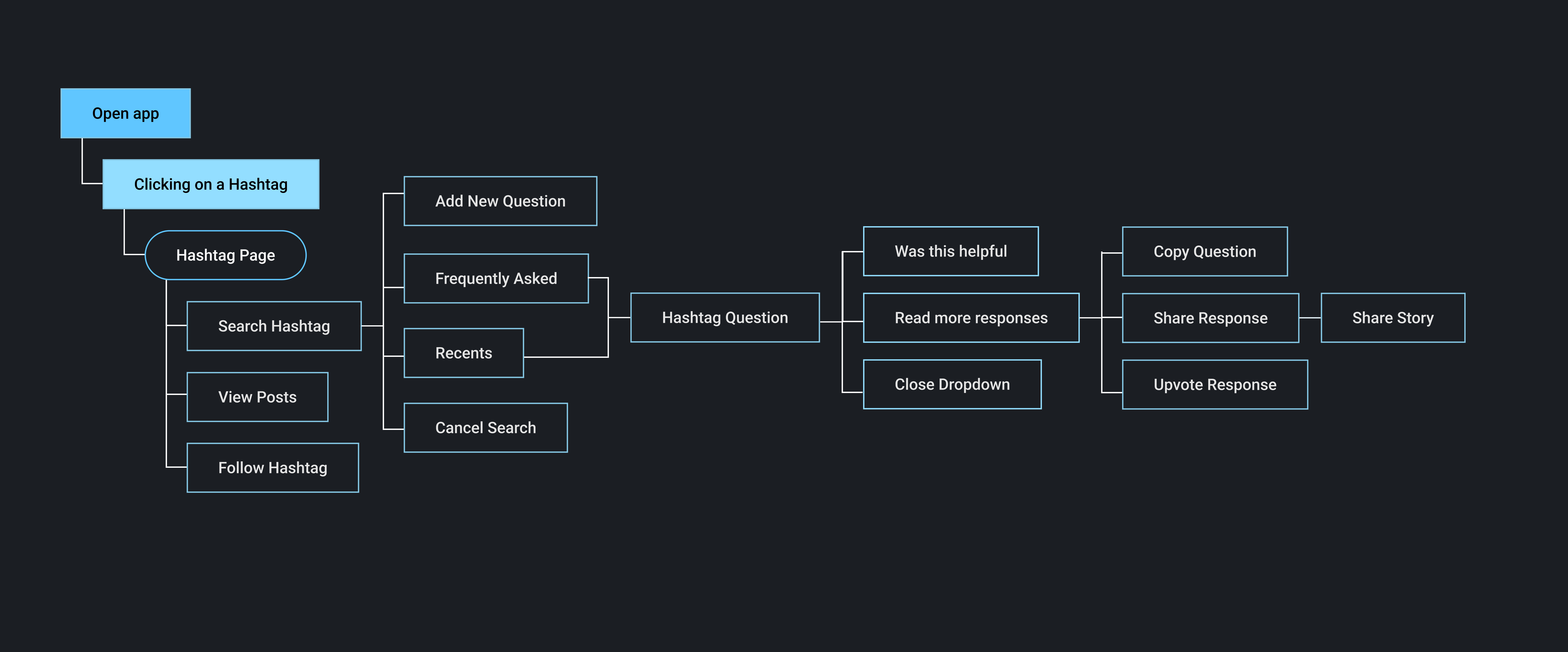
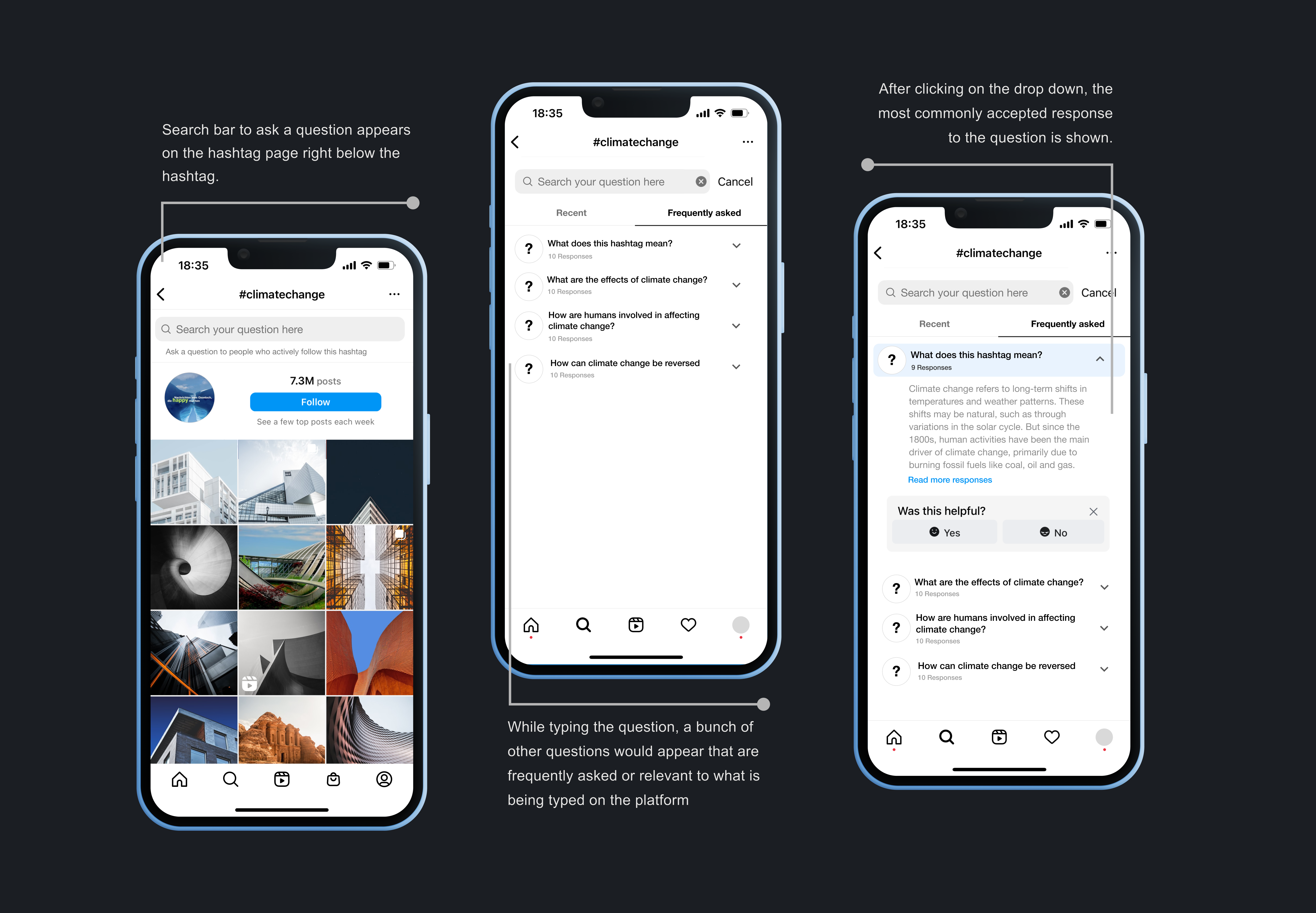
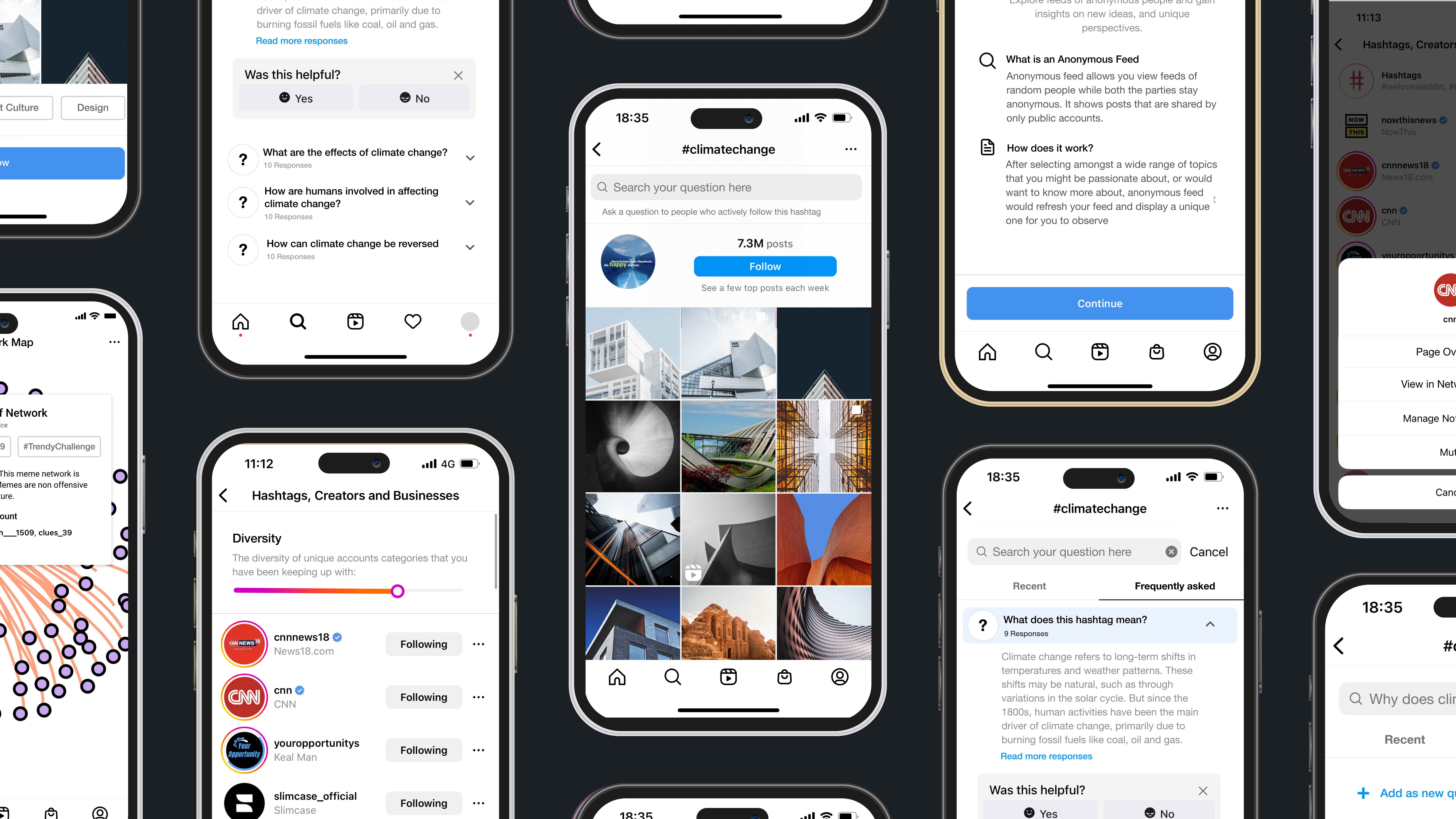
INTERVIEWING

Shin (2011) came up with a new and unique education style to help art students come out of their social comfort zones by asking them to conduct interviews of students from other cultures to help them to be able to empathise with others, and self-correct their stereotypes.

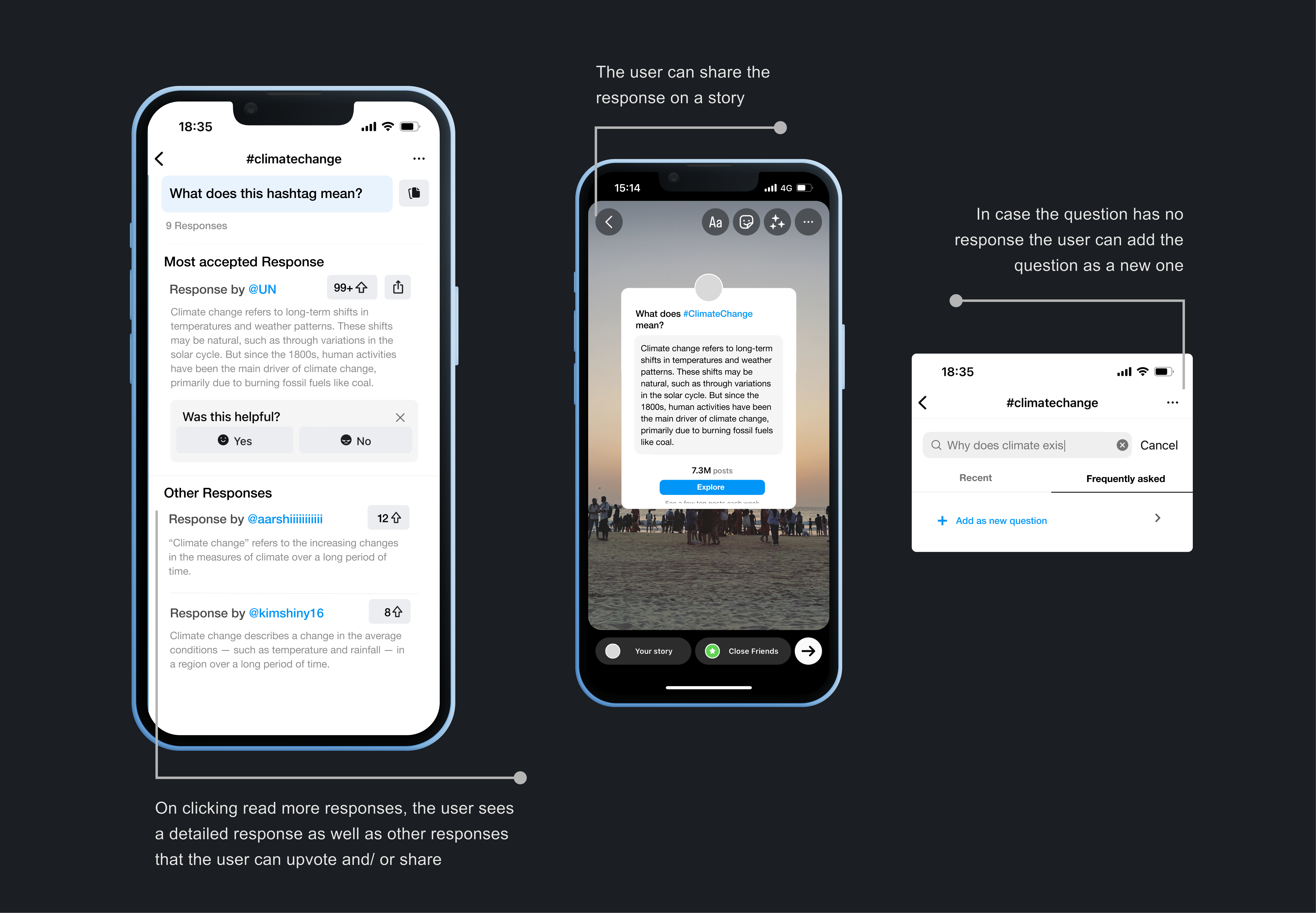
If people can ask questions about a particular culture/opinion that they are alienated towards on social media and receive answers from people who actively follow that culture/ embrace that opinion, they might have a change of mind in terms of that culture. Moreover, sharing the answers that they have received to their community might increase their engagement, and help break the echo chamber that they and others who trust them are in.

INFORMATION ARCHITECTURE

FINAL UI

SOLUTION 2

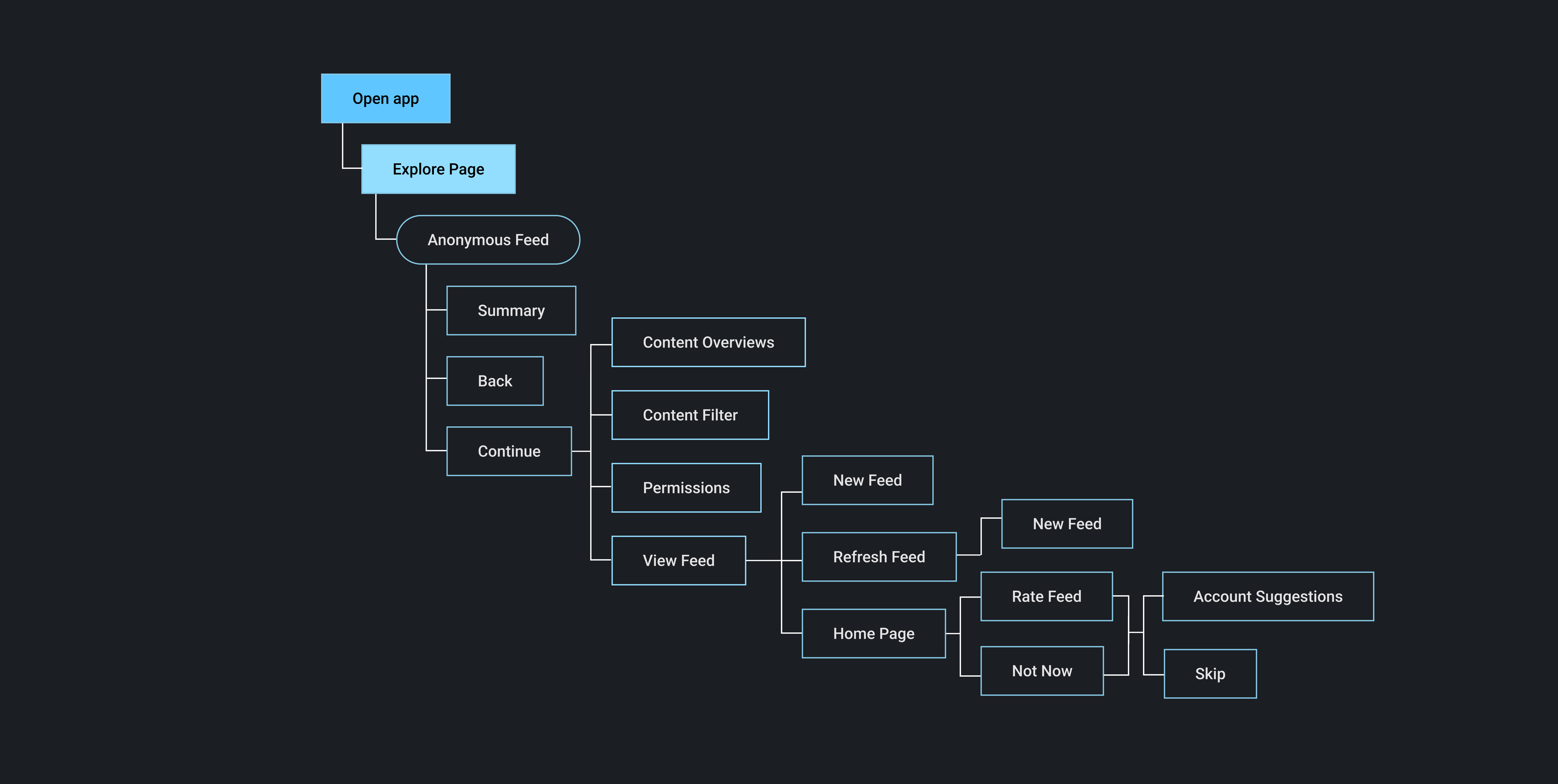
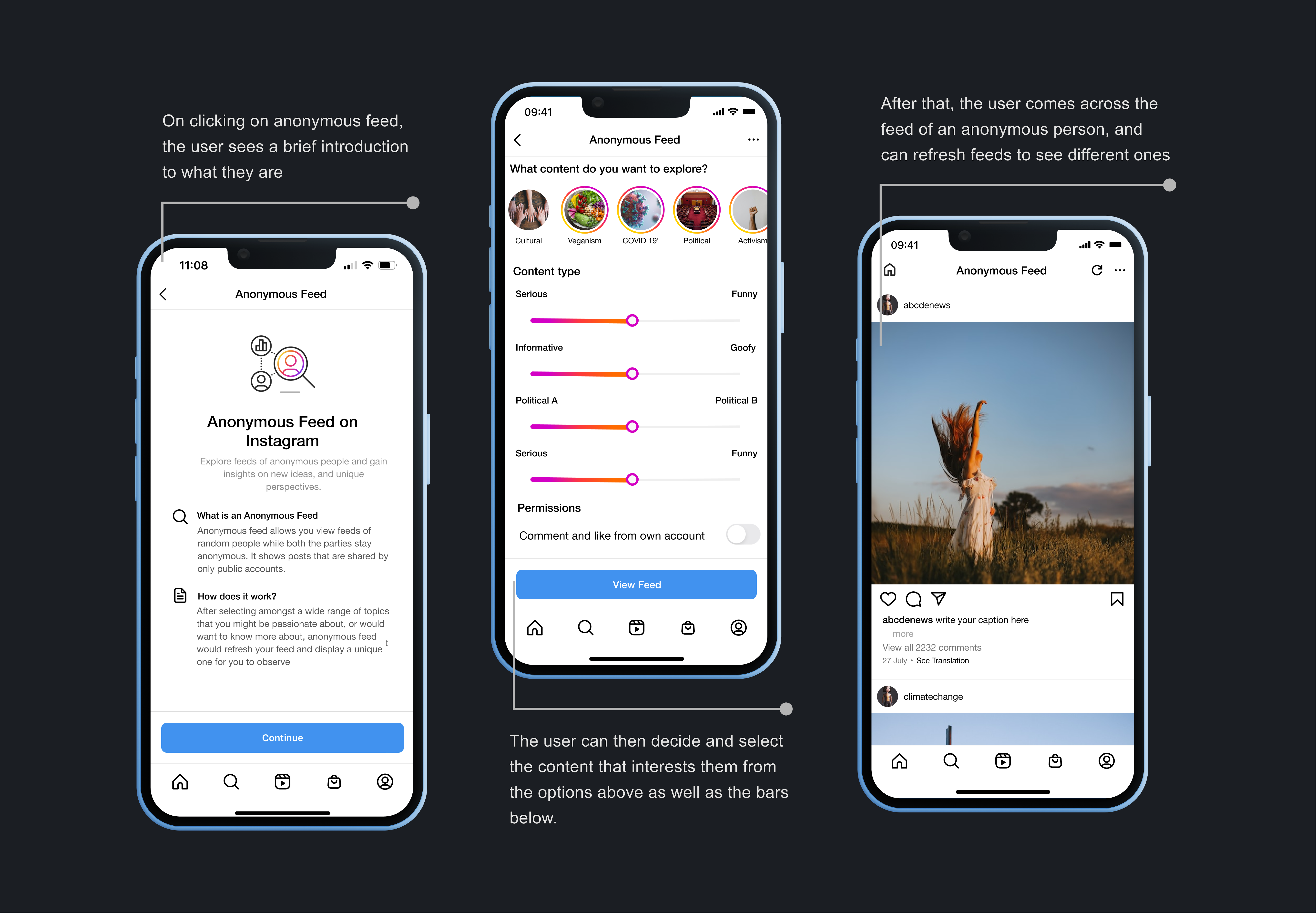
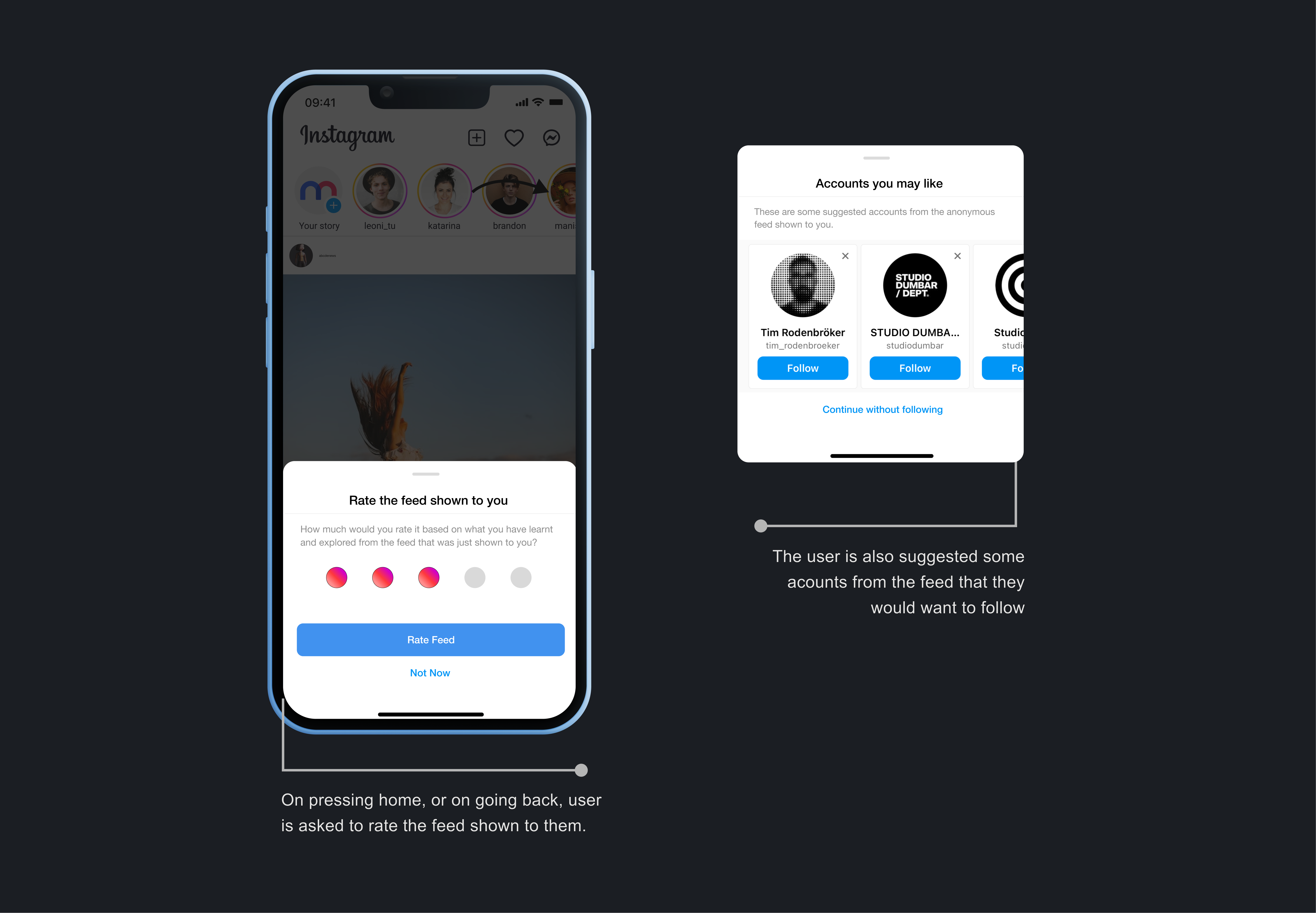
ANONYOUS FEED

In an experiment done by a few students at MIT to understand the effect of perspective-taking to reduce affective polarisation on Social Media, users were shown 200 autogenerated feeds that were not similar to theirs through a chrome extension and were asked to go through that feed and answer a few questions. While this extension was only made to achieve results for research, a similar feature could exist in social media, where people can explore feeds of other anonymous users, and learn from those feeds, exploring new opinions, ideologies, and pages.

Most feeds are not extremely opinion based and are instead a mixture of different types of content, some posts might oppose the opinion of the viewer, while the others might be new to them. The kind of content on the feed, the order that it’s in, or the quality of the content could spark a flame in the readers’ minds, and maybe, bring them out of the echo chamber.

INFORMATION ARCHITECTURE

FINAL UI

SOLUTION 3

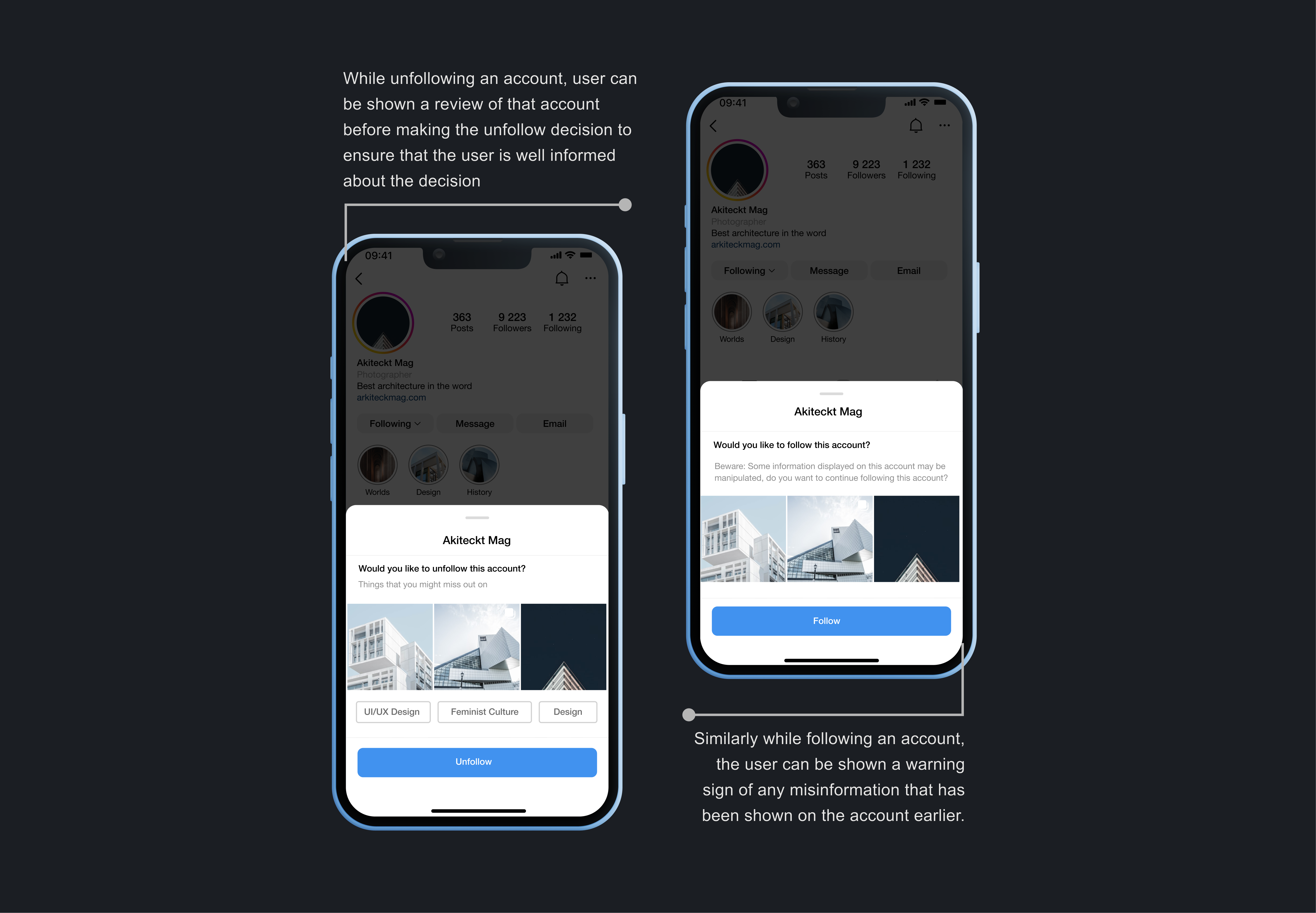
DELAYED DECISION MAKING

It has been stated that when people are given more time to make a decision, their decision tends to be more informed (Lilienfeld et al. (2009). This might not entirely remove, but reduce the impact of biases that take place when a person is inside an echo chamber.

Giving people an option to review their decision, might delay the decision making time, as people would be thoughtful towards taking that particular decision. This delay can be while following/unfollowing a hashtag/source of information, or commenting something offensive on someone’s post on social media platforms.

INFORMATION ARCHITECTURE

FINAL UI

SOLUTION 4

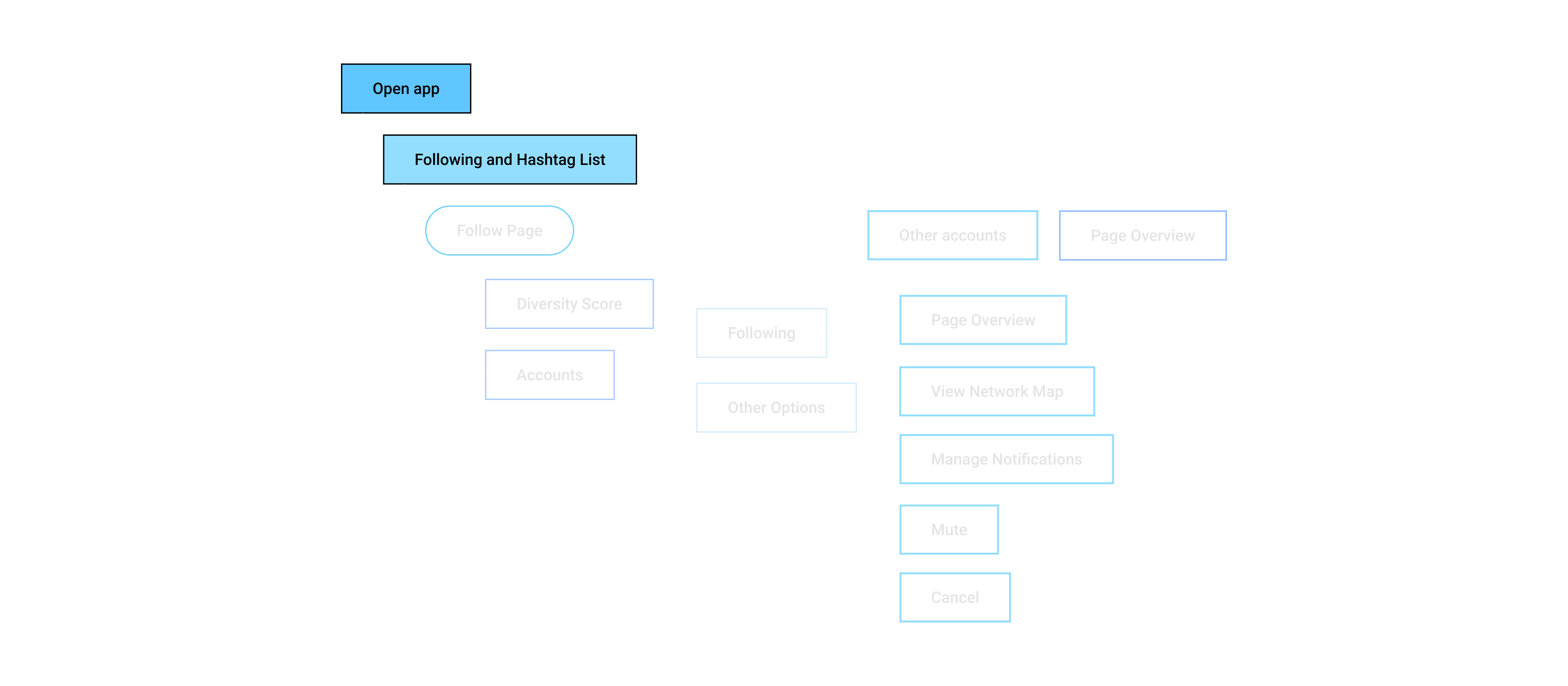
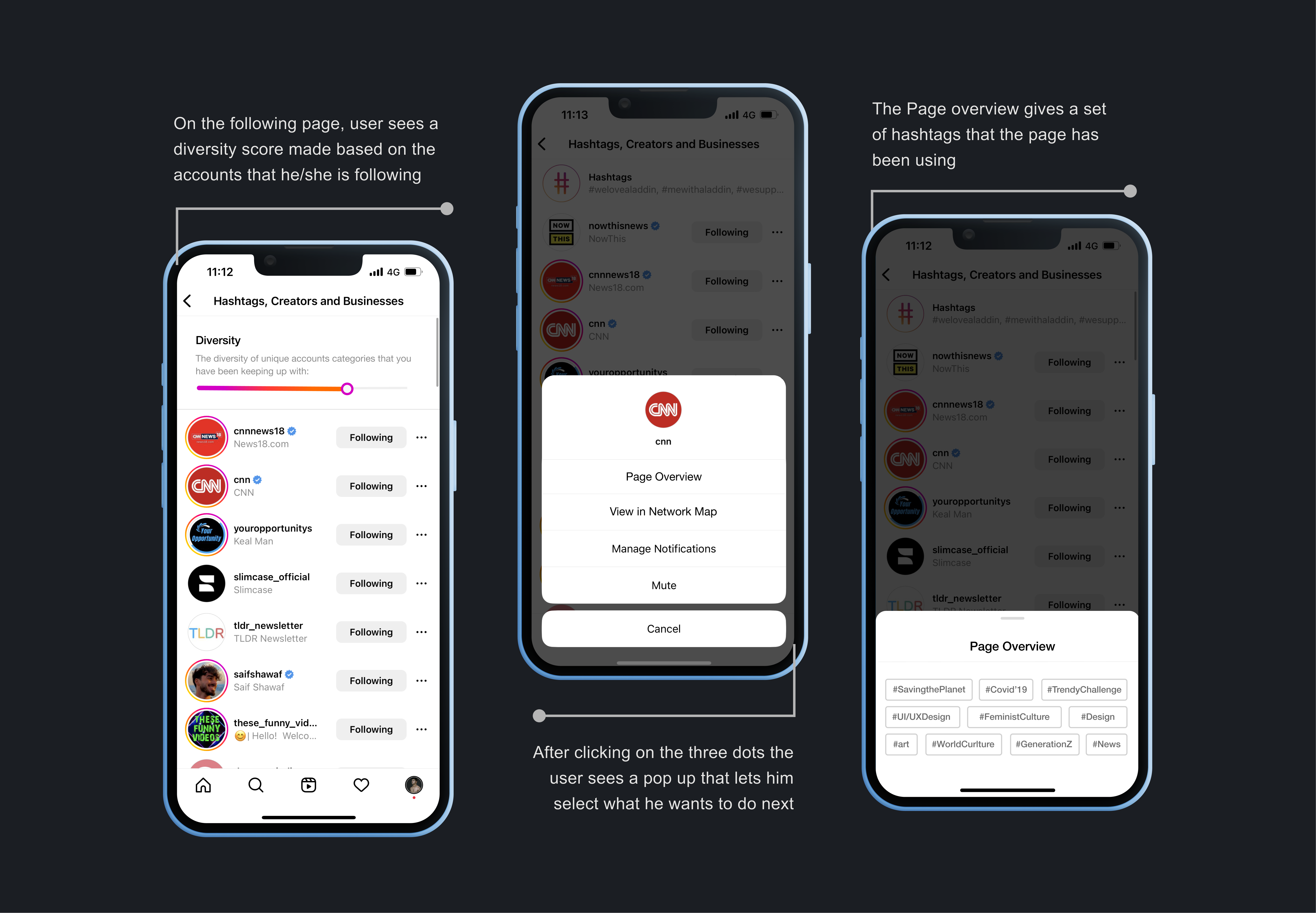
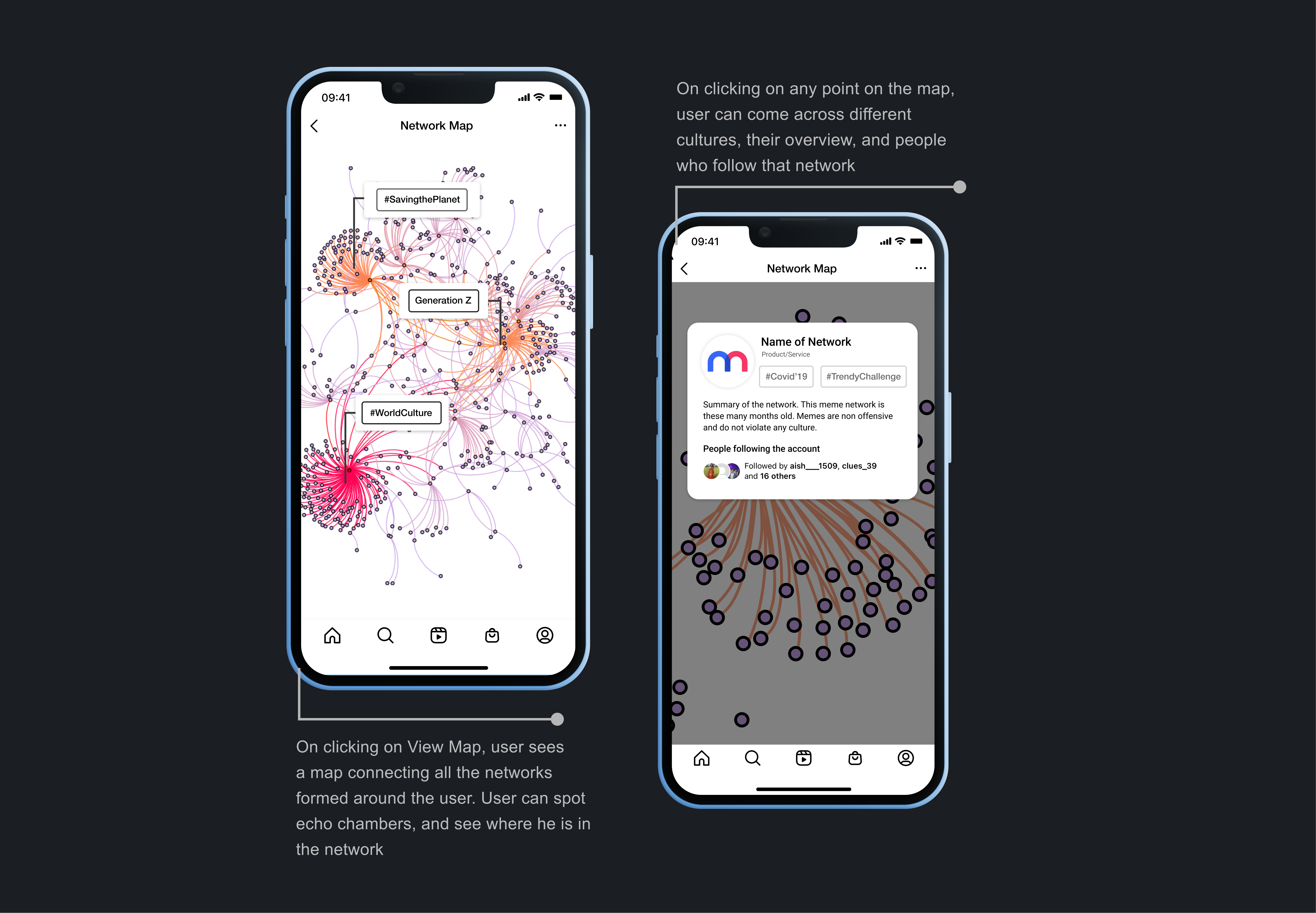
SOCIAL NETWORK VIEW

Social Mirror is a work-in-progress project designed to display multiple different networks that are available on the Twitter platform, It collects data from the user’s Twitter activities, and displays politically active parts of their social network.

If a similar ideology could be used in social media, and users could see multiple networks that are formed around them, using which they could identify whether or not they are in an echo chamber, and if they are, then what kind of echo chamber are they in. This could help them in escaping their echo chamber, and exploring new ones.

Moreover, they could come across a list of cultures/opinions/ideologies that their trusted sources are inclined towards, eventually helping them explore new viewpoints, and come out of their echo chambers.

INFORMATION ARCHITECTURE

FINAL UI

STEP 1

DESIGN BRIEF

STEP 2

SECONDARY RESEARCH

STEP 3

IDENTIFYING POSSIBLE SOLUTIONS

SOLUTION 1

Interviewing

A couple of teenagers were asked to interview people who were from a culture not known to them/ people who had a different viewpoint from theirs on a selected topic. The interview questions were based on their viewpoints, why they thought that way, etc. 

WHY THIS MIGHT HAVE HELPED

The teenagers were exposed to new cultures and new perspectives/opinions.  
Since it wasn’t a conversation/debate, they didn’t have to put their viewpoints/ideologies forward- convincing them to carefully listen to the other person’s perspective 
Since the interview that they had been doing was for a project, they had to ensure that the information collected was from a reliable source and was end-to-end. This helped them to sympathise with people that had a different opinion from theirs without having the thought of forcing their opinions on them. 

WHAT COULD HELP

Asking the students to share their findings with others would have convinced them to further understand the opposite viewpoint so that when there are any questions asked they can answer correctly. 
Students of the same/ similar culture could have debates with each other on different cultures. For example, Student A and B who support politician A could debate on the points that prove which one amongst politician B/ C is better by interviewing supporters with both these opinions.
This way, they would be exposed to other perspectives, as well as be able to defend a perspective that is not theirs, helping them to slowly escape from the echo chamber that they are currently in. 

DRAWBACKS

The interviewers might get triggered when facing an opinion that is not theirs, and might feel the urge to talk back/ get angry at the other person.
This would result in arguments, and eventually lead to them being further convinced that the views they hold are right. Language barriers while interviewing 

SOLUTION 2

DELAYED DECISION MAKING

When decision making is delayed, it cannot be entirely removed but can reduce the impact of biases, resulting in lower chances of entering into an echo chamber uninformed. 

WHY THIS MIGHT HAVE HELPED

Since the decision making is delayed people often get more time to think open their opinions before making a decision, reducing the chances of them blatantly taking uninformed decisions while entering into an echo chamber. 
Since they get more time to think, they might also end up getting more anxious about their opinion and might end up looking for it from newer sources. This would open them up to new perspectives.
It takes time to build trust, with more time given to them to determine whether or not they would want to support an opinion, they would start trusting other sources, thereby finding it easier to moderate their opinion.

WHAT COULD HELP

An opportunity to allow delayed decision making along with some alternate sources that can be shown to the viewer before they move on to the decision making. 
For example, on food delivery apps, after the food is added to the cart, the user sees multiple options such as coupons and offers, adding a tip, summary of the delivery, option to select cutlery, delivery instructions, gift cards etc, which gives them more time to review their order, reconsider their options before placing it. 

METHODS

The decision made on a particular topic
Selecting a perspective that needs to be supported
Trusting an influencer or an individual

RISKS

The interviewers might get triggered when facing an opinion that is not theirs, and might feel the urge to talk back/ get angry at the other person. This would result in arguments, and eventually lead to them being further convinced that the views they hold are right. Language barriers while interviewing 
Users might get impatient and annoyed, and might stop using that source of information Time given to users might act backwards, and because of confirmation bias, they might end up convincing themselves further on that opinion, and eventual go further inside the echo chamber. 

SOLUTION 3

Encounter with close people

Echo chambers tend to revolve around encounters with people that they are close to –For example encounters such as a member of the family, a child/close friend coming out etc matter because a personal connection comes with a substantial store of trust.

WHY THIS MIGHT HAVE HELPED

Since the core of the encounter is built on trust, i.e. since the person that’s inside the echo chamber already trusts the other person, who is out of that echo chamber, the person might be slightly more open to trying to understand the other person. 
Even though trust takes time to build, it’s not too difficult to get people to trust someone on social media. The trust doesn’t have to be based on a deep connection, or it shouldn’t involve the same amount of reliability that connection with family or close friends involved, it should just be enough to ensure that the source of information that is being provided by the trusted source is reliable. 

QUESTIONS

Can this be incorporated into a design?
It’s a natural tendency for humans to trust others, that’s how the world works, can something be done to ensure that people trust the right source of information? 

DRAWBACKS

This is a time-consuming process, the trust that comes doesn’t build up in a day, or two, it requires constant efforts from both sides, the side of the person, who is in the echo, and the person who isn’t.
It also requires patience to be able to understand the other person 
This situation might turn complicated, and not provide any results if the person in the echo chamber also trusts someone with similar views as theirs, and together, their forced opinion might instead act negatively and bring back the person who has come outside the echo chamber, back inside the echo chamber

SOLUTION 4

Cartesian epistemic reboot

 It refers to a reboot where the person completely abandons everything that the person believed in and immerses himself broadly and open-mindedly into everything he missed out, spending years building a new belief system from scratch, only based on generosity and trust. 

WHERE DOES IT HELP

Helps when the echo chamber that the person is currently in has been imposed upon the person for a long time, say for example, since when the person was born. 
When the echo chamber also affects the culture, values, and the core of the person’s upbringing, it becomes difficult to allow small changes to help the person. Here is where a cartesian epistemic reboot helps.

DRAWBACKS

It’s a It is difficult to implement this reboot without the person’s knowledge and acceptance as it is a major change in a person’s upbringing.
The reboot requires multiple assets and resources which the person who is in an echo chamber needs to trust 
The reboot might take up to a few years as it changes the person’s perspective from the very root of the person’s existence, the person is like newly born. 
The reboot cannot be completed with small changes that can be made online. The changes that need to be made would be to the person’s lifestyle, their way of living, their small and big choices, their sources of trust etc. 

WHAT NEXT?

To be able to get a person to start a cartesian epistemic reboot, a lot of convincing would be required, but if a social media platform is considered, most people that are on the platform, already have a similar set of views. The reason that they are on social media is that at some point they all made a set of similar decisions that makes them understand each other, and be able to actively communicate with each other on the platform.

SOLUTION 5

MEDIATOR

Social media platforms can act as mediators and can try to deal with fake news by giving warnings and labels when they find out that a news source is manipulated or filled with misinformation. This solution is being implemented throughout some social media platforms such as Instagram, but the level of accuracy that the algorithm holds might not be as reliable. 

WHY THIS CAN HELPED

Showing warning signals and labels on a news source might help in convincing people that a particular news source might be manipulated and unreliable. When the user comes across the label, they will think twice before reading and acknowledging the source. 
As a user of that platform, there is already some amount of trust that has been built up for the platform, and since the label is put up by the platform itself, the user is more likely to believe in that source, and not fall into an echo chamber in the first place. 

HOW IT WORKS

Social media platforms are currently down-ranking contents in feeds and stories that have been rated false by third-party fact-checkers 
Image matching technology is used to find further instances of the content and apply the label. Moreover, if something is related false or partly false on the platform, all identical content would be rated so too.
Instagram and Facebook have also decided to label a link of credible sources and articles on those pieces of false information. 

DRAWBACKS

These platforms might accidentally remove legitimate information which might affect the readers. For example, Facebook ended up removing legitimate information during the beginning of covid19 in an attempt to remove false information. This could have affected the readers as they might have missed out on something that they should have known earlier
Since the app relies on third-party fact-checkers, it becomes nearly impossible to read and understand the millions of sources of news from all over the world, in different languages, explained using different mediums, on different topics, and ensure that these sources have been correctly stated. 
These fact-checkers can only work where there is news that can be classified as wrong or right. When people have different perspectives, there may not be a right or wrong, in that case labelling a piece of information as “misinformation” or “fake news” might not be the best thing to do. 

SOLUTION 6

NEWS AGGREGATOR WEBSITES

News Aggregator websites remove the tedious search click search click process and show users multiple sources of information in one place. 
Example: Rotten tomatoes is a website that helps the user by collecting reviews of a movie from all over the web. One can read up to 300 reviews of a movie from both digital media powerhouses to cool blogs, without any effort 
Google News is another example of an aggregator website, but like other social media platforms, google news might not be the primary source of information for most users. 

WHY THIS CAN HELPED

Since aggregator websites show the same information by multiple news sources in the same place, people who view the information on that website can come across multiple perspectives of that information. Because of this, the opinion that they form is well informed and not manipulated by someone else’s/some other news source’s perspective. This can prevent them from getting into an echo chamber.

DRAWBACKS

Sources might not always be right. For example, if a content aggregator website puts up information from a blog written by someone, and the author/s of that blog, haven’t fact-checked the information correctly, the aggregator website would also have a negative effect as this misinformation would be added to their website, and users reading that website would trust the website, and be more likely to believe that source of fake news. 
The same content can be repeated multiple times as different sources might be sharing the same information, and the readers might get bored, and not be able to come to the point where they can read the information that points to a different perspective.

SOLUTION 7

ECHO CHAMBER ESCAPE

This website is a diversity-first publication that covers interviews, opinion pieces, and features with those who are not regarded as ‘Majority’. They talk with them and not over them about mainstream issues, and what their perspectives need the reader to hear. 

HOW IT HELPS

Helping people come across newer perspectives might help them be more informed about their decisions on judging which perspective is right and which is not.
Sometimes, local news channels end up focusing all the attention on a single perspective purely because that perspective is more attention-seeking and can gain more sympathy, because of this reason, the other perspective stays hidden to the public. 
A website that covers interviews and opinions of people who are in the minority can help these hidden perspectives come out, so people can view sources as a whole and not just as what news channels/ their reliable sources show to them. 

WORKS FOR

People who know that they are in an echo chamber, and are willing to put in efforts to get out of it. 
People who are curious to know more
People who do not originally support the perspective of the majority/ are sceptical about that perspective. 

DRAWBACKS

These kinds of websites may not be the user’s first choice of source of information. As a reader, it is more important to come across what the majority thinks first, and then the minority is considered. 
Most times, what happens is that when the viewer is looking into the majority, they already slowly form their opinion, and are inside the echo chamber up to a certain extent. This might stop them from going into such websites in the first place. If they don’t enter the website, they won’t know the minority’s opinion, and eventually, they would go deeper and deeper into the echo chamber, and not be able to consider the other perspective. 

SOLUTION 8

FEED CHANGING

Replacing the user’s social media feed with someone else’s feed can help people explore diverse perspectives. They can see the feeds of people similar to them, or people who have a similar opinion as theirs, and the feed of those, who have a completely different opinion as theirs 

WHY THIS CAN HELPED

People won’t just come across one or two posts that are different from theirs, they will come across a variety of posts. It would be like seeing the world from a different person’s perspective. One connection would build up another, and the user would be able to identify and sympathise with the other person’s perspective.
For example, the user (who does not believe in global warming caused by humans) might see the feed of someone who believes that global warming is caused by humans. The person wouldn’t just come across a feed full of posts on global warming and its effects, they would also come across other things that may have led to the decision that the person whose feed it is might have taken. For example, videos that show plastic bags being stuck in marine animals may not be directly relevant to climate change, but it would show how humans have polluted the see and this might help the other person realise that humans can be blamed for harming the animals, which might act as a start to help him come out of the echo chamber. 

WHAT ELSE CAN IT HELP WITH

The user can learn something new, even if it first changes their mind entirely 
The user will be able to understand why some people might identify with the views shown in this feed. 
They might be interested in exploring further the different aspects of the feed that they did not understand, eventually opening them to newer perspectives.
This whole idea could be in the form of an activity or a game that users should play out of curiosity as people find it fun to come across different feeds to look for funny stuff

DRAWBACKS

Privacy issues- People might not want to their social media feed with strangers. 
The feeds might not be in the language that they are comfortable in The feeds might have content that they do not want to come across/ explicit content, which could trigger them

SOLUTION 9A

DISCOURAGING COMPLETE DISSOLUTION OF TIES

Discouraging complete dissolution of ties with the users who disagree with one’s opinion can be an alternative mechanism to solve echo chambers. Some social media platforms are experimenting with solutions like snooze buttons or the possibility to block a certain type of information.

HOW DOES IT WORK

Since people can completely cut off ties with other sources of information in social media they stop receiving any information from that source. The reason they unfollow might be because they don’t like the content shared by that source/ the content that the source shares might go against their opinion, or be too extreme for them to comprehend. In cases like these using methods such as the snooze button for an account or the possibility to block a certain type of information might prevent the user from being completely alienated from that information. This way, they would not easily step into an echo chamber of opposing views. 

DRAWBACKS

People might not understand in what cases can these mechanisms be used. They might just ignore this possibility and straight unfollow/stop seeing the content that they do not like. These might only be used in cases where the user does not want the other person to feel bad about being unfollowed. 
The snooze option might instead hide the information the user should be seeing from that source. This would not be of any help at all.  

SOLUTION 9B

ALERTING USERS AND EXPOSING SOURCE

Another approach could be to alert users who are about to unfollow, of the kind of information that they might be missing out on if they unfollow that particular source
Exposing the source of information reposted by friends and recommending similar users and sources might convince the user to believe in the information. 

HOW WILL IT WORK

Alerting the users with the kind of information that they might be missing out on can convince the person to not unfollow that account. In response to that, the information that the user sees can be a mix of what the user wants to see, and what the user is new to, helping them come out of echo chambers, and not lose interest in the particular source as well. 
Since people will come across recommendations of other people who they “trust” they might start trusting the source of that information where they have received a recommendation from. 
This will slowly help them to come out of the echo chamber that they are currently in and identify and understand newer opinions and perspectives

DRAWBACKS

People People might ignore the alert 
People might not be convinced most of the times
Privacy constraints: People might not want others to see who they are following, and the posts that they have liked. (Mind your business attitude) 

SOLUTION 10

BIRD'S EYE VIEW

By presenting social media users a bird’s eye view of their ideologically fragmented social media network and showing them how diverse their current social media feed is, can further motivate them to explore new aspects of what they have been missing out on. The social mirror is a web application that allows users to explore a sample of their politically active connections. It shows the formation of multiple echo chambers and allows them to guess where they think they are in the connection map form. It then shows them where they are and allows them to explore other diverse aspects of their connection 

WHY THIS CAN HELPED

Using this mechanism people are exposed to different cultural networks which allows them to open up to different opinions, perspectives that might not be the ones that they are supporting, eventually helping them to break out of echo chambers. 
All this would happen with the incentive to know more.
This might also make them aware of the echo chambers that they are in. Most people do not know what echo chambers they are in, it’s not something that happens consciously. 
Having an overview of the diverse connections and political and cultural networks that are around them will allow them to spot their location and see the kind of echo chambers that they are in. 

DRAWBACKS

People might want to go deeper into the echo chamber they are currently in (they might feel like they are not deep enough, and might instead start to follow more sources that will reinforce their trust within the echo chamber) 
Instead of looking at diverse ideologies and perspectives, people might end up looking for opinions that match with theirs and only look towards directions that they think supports their ideas, pushing them further inside the echo chambers. 
STEP 4

BUILDING CRITERIA

  • The solution/s should provide an acceptable level of benefits in terms of helping people escape from their echo chambers.
  • The solution/s should also be able to help people who are already stuck in an echo chamber, and not just prevent those outside from entering.
  • They should be able to solve obstacles such as lack of trust, manipulation of trust, and ensure, that the users know who they are trusting
  • They should provide a solution to echo chambers, not epistemic bubbles.
  • The time that they take could be longer, but the results should be productive in the ability of the person to fall into echo chambers.
  • The initial changes that need to be made for the solution should be smaller, easier to incorporate on online platforms, or in any other form, making sure that people do not get distracted from them easily.
  • The materials required to make these changes should constitute maximum efforts from the design end but minimum efforts should be made from the side of the target audience.
  • The changes made could be personalised to a particular echo chamber, but there should be slight variations of these that can be used in other echo chambers.
  • These solutions should be acceptable to the target audience
    - It should not annoy them
    - It should not force them to do something they aren’t willing to do
    - It should aim to change slowly and steadily without making them feel overwhelmed by their structure and size
    - It shouldn’t offend them in any way.
  • It should be acceptable to the people who are implementing the solution
    - It should be easy to implement
    - It should not require any external technology that the person implementing the solution cannot afford.
  • If it involves any amount of risk
    - The risk should not be greater than the problem that already exists.
    - The risk should not impose any harm to the target audience
    - Risks should not have external major side effects

EVALUATING SOLUTIONS

STEP 5

IDEATING SOLUTIONS

REFERENCES

  1. Nguyen, C Thi. “Escape the Echo Chamber .” aeon. Accessed December 13, 2021. https://cs50.harvard.edu/x/2021/labs/10/chamber.pdf.
  2. “Tim Schneegans Escaping the Comfort Zone: A Three-Level Perspective on Filtering Effects and Counter-Measures.” n.d. http://ordnungspolitisches-portal.com/wp- content/uploads/2019/05/2019-5-Schneegans-Escaping-the-comfort-zone.pdf.
  3. “7 Examples of an Echo Chamber.” n.d. Simplicable. Accessed December 13, 2021. https://simplicable.com/en/echo-chamber.
  4. Rasmussen, Louise. 2018. “Confirmation Bias: 3 Effective (and 3 Ineffective) Cures - Global Cognition.” Global Cognition. October 12, 2018. https:// www.globalcognition.org/confirmation-bias-3-cures/.
  5. “‘Candid,’ the Anonymous Chat App, Enforces Civility with AI.” n.d. Engadget. Accessed December 13, 2021. https://www.engadget.com/2016-07-21-candid-the- anonymous-chat-app-enforces-civility-with-ai.html.
  6. “Candid Launches to Be the New Secret, but without the Vitriol and Harassment.” 2016. VentureBeat. July 21, 2016. https://venturebeat.com/2016/07/21/candid- launches-to-be-the-new-secret-but-without-the-vitriol-and-harassment/.
  7. Kitchens, Brent, Steve L. Johnson, and Peter Gray. 2020. “Understanding Echo Chambers and Filter Bubbles: The Impact of Social Media on Diversification and Partisan Shifts in News Consumption.” MIS Quarterly 44 (4): 1619–49. https://doi.org/ 10.25300/misq/2020/16371.
  8. GCF Global. 2019. “Digital Media Literacy: What Is an Echo Chamber?” GCFGlobal.org. 2019. https://edu.gcfglobal.org/en/digital-media-literacy/what-is-an- echo-chamber/1/.
  9. Seneca, Christopher. 2020. “How to Break out of Your Social Media Echo Chamber.” Wired. September 17, 2020. https://www.wired.com/story/facebook-twitter-echo- chamber-confirmation-bias/.
  10. Wollebæk, Dag, Rune Karlsen, Kari Steen-Johnsen, and Bernard Enjolras. 2019. “Anger, Fear, and Echo Chambers: The Emotional Basis for Online Behavior.” Social Media + Society 5 (2): 205630511982985. https://doi.org/ 10.1177/2056305119829859.
  11. “R/AskReddit - [Serious] How Do We Break out of Our Online Echo Chambers?” 2018. Reddit. 2018. https://www.reddit.com/r/AskReddit/comments/8ym6k6/ serious_how_do_we_break_out_of_our_online_echo/.
  12. “Echo Chambers.” n.d. Mission Winnow. Accessed December 13, 2021. https:// www.missionwinnow.com/en/pmi/what-is-open-mic/echo-chambers/.
  13. “7 Great News Aggregator Websites You Should Check Out.” 2018. ThemeIsle Blog. December 24, 2018. https://themeisle.com/blog/news-aggregator-websites- examples/.
  14. Br, Steinar, and slet-Published 03 06 2021 Denne saken er også tilgjengelig på norsk. 2021. “Social Media’s Echo Chambers Not Such a Big Problem.” Norwegian SciTech News. June 3, 2021. https://norwegianscitechnews.com/2021/06/social-media-less- impactful-than-feared/.
  15. “Project Overview ‹ Social Mirror.” n.d. MIT Media Lab. Accessed December 13, 2021. https://www.media.mit.edu/projects/social-media-mirror/overview/.
  16. Bar-Gill, Sagit, and Neil Gandal. 2017. “Online Exploration, Content Choice, and Echo Chambers: An Experiment.” VoxEU.org. April 10, 2017. https://voxeu.org/article/ online-exploration-content-choice-and-echo-chambers.
  17. September 30th, 2020|Democracy, culture, Jay Hmielowski, Michael Beam, and Myiah Hutchens|1 Comment. 2020. “Why Trying to Break People out of Their Echo Chambers Might Be Counterproductive.” USAPP. September 30, 2020. https:// blogs.lse.ac.uk/usappblog/2020/09/30/why-trying-to-break-people-out-of-their-echo- chambers-might-be-counterproductive/.
  18. Cinelli, Matteo, Andraž Pelicon, Igor Mozetič, Walter Quattrociocchi, Petra Kralj Novak, and Fabiana Zollo. 2021. “Dynamics of Online Hate and Misinformation.” Scientific Reports 11 (1). https://doi.org/10.1038/s41598-021-01487-w.
  19. Lo, Kuan-Chieh, Shih-Chieh Dai, Aiping Xiong, Jing Jiang, and Lun-Wei Ku. 2021. “Escape from an Echo Chamber.” Companion Proceedings of the Web Conference 2021, April. https://doi.org/10.1145/3442442.3458613.
  20. “About Us.” 2019. Echo Chamber Escape. November 1, 2019. https:// echochamberescape.com/about/.
  21. “Bond 1 Russell Bond Professor Wazoua Critical Thinking and Writing I.” 2019. http:// rljbond.com/wp-content/uploads/2020/02/Technology-and-Political-Polarization.pdf.
  22. Bail, Chris. "2 Why Not Break Our Echo Chambers?" In Breaking the Social Media Prism: How to Make Our Platforms Less Polarizing, 12-25. Princeton: Princeton University Press, 2021. https://doi.org/10.1515/9780691216508-002
  23. Jiang, Bohan. n.d. “Mechanisms and Attributes of Echo Chambers in Social Media.” Accessed December 13, 2021. https://arxiv.org/pdf/2106.05401.pdf.
  24. Karlsen, Rune, Kari Steen-Johnsen, Dag Wollebæk, and Bernard Enjolras. 2017. “Echo Chamber and Trench Warfare Dynamics in Online Debates.” European Journal of Communication 32 (3): 257–73. https://doi.org/10.1177/0267323117695734.
  25. Balsamo, Duilio, Valeria Gelardi, Chengyuan Han, Daniele Rama, Abhishek Samantray, Claudia Zucca, and Michele Starnini. 2019. “Inside the Echo Chamber: Disentangling Network Dynamics from Polarization.” https://arxiv.org/pdf/1906.09076.pdf.
  26. Saveski, Martin, Nabeel Gillani, Ann Yuan, Prashanth Vijayaraghavan, and Deb Roy. n.d. “Perspective-Taking to Reduce Affective Polarization on Social Media.” Accessed December 13, 2021. https://arxiv.org/pdf/2110.05596.pdf.
  27. Sasahara, Kazutoshi, Wen Chen, Hao Peng, Giovanni Luca Ciampaglia, Alessandro Flammini, and Filippo Menczer. 2020. “Social Influence and Unfollowing Accelerate the Emergence of Echo Chambers.” Journal of Computational Social Science, September. https://doi.org/10.1007/s42001-020-00084-7.
  28. Lohani, Archit. n.d. “Countering Disinformation and Hate Speech Online: Regulation and User Behavioural Change.” ORF. https://www.orfonline.org/research/countering- disinformation-and-hate-speech-online/.
  29. Gillani, Nabeel & Yuan, Ann & Saveski, Martin & Vosoughi, Soroush & Roy, Deb. (2018). Me, My Echo Chamber, and I: Introspection on Social Media Polarization. 10.1145/3178876.3186130. https://www.researchgate.net/publication/ 323571298_Me_My_Echo_Chamber_and_I_Introspection_on_Social_Media_Polarizati on
  30. Shin, R. (2011). Social justice and informal learning: Breaking the social comfort zone and facilitating positive ethnic interaction. Studies in art education, 53(1), 71-87.
  31. Lilienfeld, S. O., Ammirati, R., & Landfield, K. (2009). Giving debiasing away: Can psychological research on correcting cognitive errors promote human welfare? Per- spectives on psychological science, 4(4), 390-398.
  32. Hardwick, Joshua. 2018. “How to Get Backlinks: 7 Tactics That Don’t Require New Content.” SEO Blog by Ahrefs. December 11, 2018. https://ahrefs.com/blog/how-to- get-backlinks/.
  33. “ITS Education Asia Article - FINDING POSSIBLE SOLUTIONS.” n.d. Www.itseducation.asia. https://www.itseducation.asia/article/finding-possible- solutions.
  34. “Writing a Case Study Analysis | Ashford Writing Center.” n.d. Writingcenter.uagc.edu. https://writingcenter.uagc.edu/writing-case-study-analysis.
  35. Rob Steffens. 2018. “15 of the Very Best Case Study Examples.” Bluleadz.com. 2018. https://www.bluleadz.com/blog/15-of-the-very-best-case-study-examples.
  36. “Solution Design Documents: What You Need to Know – Operational Excellence in Software Development.” n.d. Softwaredominos.com. Accessed December 13, 2021. https://softwaredominos.com/home/software-design-development-articles/write- solution-design-document/#6-what-does-a-good-solution-design-document-look- like.
  37. “CASE STUDY ANALYSIS a GUIDE for STUDENTS.” n.d. https://www.jcub.edu.au/ wp-content/uploads/2017/06/case-study-writing-jcub-1-case-study-analysis.pdf.